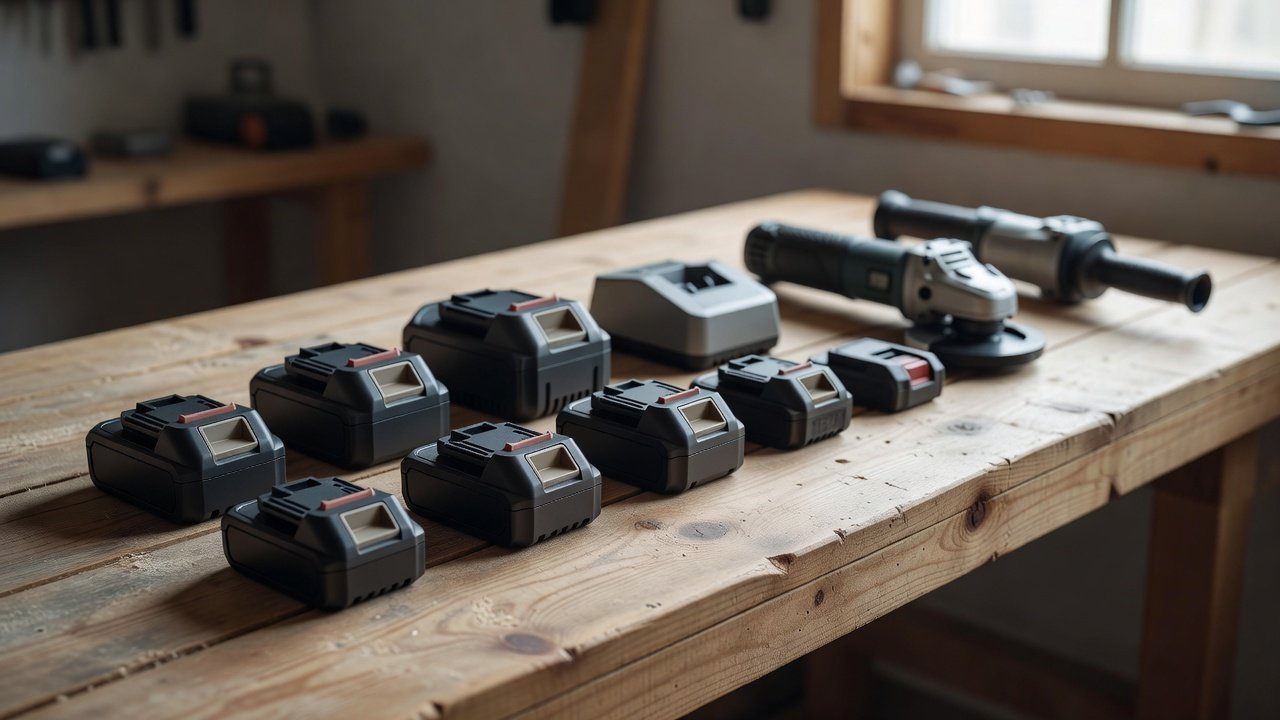
Short answer: A cordless tool battery platform is the shared battery, charger and tool range you are committing to. Voltage class sets the kind of work the system can take on, amp-hours and watt-hours describe stored energy, and brushless motors use that energy more efficiently. The long-term cost sits in the batteries, not the first drill, so price the whole system and use the checklist before you buy.
In this guide
- What a cordless tool battery platform is
- Voltage classes, and why 20V often means 18V
- Amp-hours, watt-hours and runtime
- How brushless motors change the sums
- The long-term cost of brand lock-in
- Match the platform to the work
- A decision checklist
- FAQ
- Sources
What a cordless tool battery platform is
When you buy your first cordless drill, you are not only buying a drill. You are choosing a cordless tool battery platform: one battery shape, one family of chargers, and the tools that accept that pack. Later tools are often sold body-only, with no battery and no charger, because the maker assumes you already own both. The first decision lasts longer than the tool in your hand.
The system is closed. Slides, terminals and data contacts differ by brand. An 18 volt pack from one maker will not fit another maker’s drill just because the voltage matches. Same voltage means a similar power class, not a shared fitting.
How far the range goes matters as much as the drill. Some lines barely leave drills and drivers. Others run to grinders, lights, rotary hammers and garden tools, while outdoor machines sometimes sit on another battery. List the jobs you expect over the next few years, then check those tools exist on the pack you are about to buy.
Voltage classes, and why 20V often means 18V
Voltage is electrical pressure. Power is voltage times current, so a higher voltage can deliver the same power with less current, and less current usually means less heat in the leads and the motor. That is one reason long cuts and heavy grinding sit in higher classes. Motor size, gearing and the current the pack can supply still decide what the tool will actually do.
These packs are chains of lithium-ion cells. A typical power-tool cell is about 3.6 volts in normal use and about 4.2 volts when freshly charged. Chemistry differs, so treat that as the usual pattern. If you need a precise watt-hour figure, use the nominal voltage in the manual, or the watt-hour number printed on the pack.
Three cells land near 10.8 volts nominal and about 12.6 volts full. Sold as 10.8V or 12V, this class is light in the hand. It suits assembly, cabinets and other one-handed jobs. It is a weak place to start if you often cut thick timber or drill masonry.
Five cells land at 18 volts nominal. Freshly charged, the pack is higher, often in the low 20s, and many makers round that peak into a 20V MAX label. This is the common class for home kits and site kits. An 18V pack and a 20V MAX pack built this way are the same class under two names. MAX is not a promise of more power than every 18V tool.
Ten cells land at 36 volts nominal and about 42 volts full, sold as 36V or 40V MAX. Larger saws and some outdoor tools use this class. Some tools reach it by clipping in two 18V packs. That is different from a single 36V pack: both may need to be fitted, and both are then tied up in one tool.
About fifteen cells lands near 54 volts nominal, marketed in the 54V or 60V area for harder tools and garden machines. A few platforms rearrange the cells in one shell, so the same pack runs at the lower voltage on standard tools and at the higher voltage on selected tools. Check the specification before you assume a high-voltage pack will also run your drill.
| Label you see | Usual nominal class | Typical layout | Often used for |
|---|---|---|---|
| 12V or 10.8V | about 10.8V | 3 cells | Compact drills and drivers |
| 18V or 20V MAX | 18V | 5 cells | General DIY and trade kits |
| 36V or 40V MAX | 36V | 10 cells, or two 18V packs | Larger saws, some outdoor tools |
| 54V or 60V class | about 54V | Often 15 cells, or a switched pack | High demand and garden tools |
Cell counts are the usual pattern, not a rule for every brand. Prefer a printed watt-hour figure when the pack gives one.
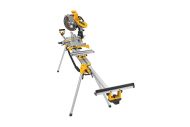
If a mitre saw is on your list, voltage and pack size matter more than the first drill that caught your eye. The DeWalt FlexVolt cordless mitre saw is a platform decision, not only a choice of blade.
Amp-hours, watt-hours and runtime
Amp-hours (Ah) measure stored charge. In a textbook sum, 4Ah can supply 4 amps for one hour, or 8 amps for half an hour. A tool’s current jumps around, and the tool stops before the cells are empty, so working time only roughly tracks the rating.
Only compare amp-hours inside one voltage class. Across classes, use watt-hours (Wh): nominal voltage multiplied by amp-hours. An 18V 5.0Ah pack is 90Wh. A 36V 2.5Ah pack is also 90Wh. They store similar energy and do not behave the same way. Higher voltage can deliver that energy at lower current, so a smaller Ah figure is not automatically a weaker battery.
At 18 volts nominal, 2.0Ah is 36Wh, 4.0Ah is 72Wh and 8.0Ah is 144Wh. If the label says 20V MAX, still multiply by the 18 volt nominal unless the maker prints watt-hours on the pack. Trust a printed Wh figure first.
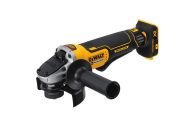
More amp-hours means more weight and, usually, a higher price. A pack around 2Ah to 4Ah is kinder overhead on a driver. A grinder or circular saw may bog down or shut off on a small pack, which is where the heavier battery earns its place. How to work with a DeWalt 20V MAX cordless grinder is one place to see a high-draw tool sitting on this voltage class.
Runtime also moves with the load, the cold, the age of the pack and the tool’s low-voltage cutoff. Driving small screws is not the same draw as ripping hardwood or grinding metal. Lithium-ion delivers less when it is cold. Capacity fades with cycles and with heat, makers quote different lives, and the cutoff leaves a reserve in the cells on purpose. Read the figure the maker states, and expect a gradual drop rather than a fixed expiry date.
Keep more than one pack so one can charge while you work. Match the size to the tool instead of putting the biggest pack on everything.
How brushless motors change the sums
A brushed motor uses carbon brushes on a commutator to switch the current. The brushes wear, and they waste a little energy as heat. A brushless motor has no brushes. An electronic controller switches the coils. More of each watt-hour can become useful work, the motor can be smaller for a given output, and there are no brushes to replace.
Brushless is not a measure of strength. A compact brushless drill can still be the wrong tool for a large hole. Read the capacity the maker states: hole size, depth of cut, disc diameter. Take the word brushless as a note about efficiency and upkeep.
The controller also protects the pack. If the battery cannot keep up, the tool may slow or stop instead of labouring on. That is useful, but it feels like a fault when the real limit is a pack that is too small for a hungry saw. Check which battery sizes the maker lists for that model.
A brushed tool can still be a fair buy for rare, light jobs, provided the platform includes the later tools you want. If the tool will be used most weeks, brushless designs are the ones makers are still extending. There is no set period after which the extra cost is recovered. Compare current prices of the two versions, on top of the same batteries.
The long-term cost of brand lock-in
The price on a starter kit is the entry fee. You are also buying a charger and batteries that wear out. Heat, repeated deep discharge and a full pack left in a hot van all age lithium-ion faster. Life and warranty both vary, so read the terms sold with the pack rather than a lifespan copied from a forum. Check today’s battery price, and assume you will buy more packs while you stay.
A fair way to compare platforms, without ranking brands:
- Note the first tool and the next three you are likely to want.
- Price a kit with a charger and two batteries. One pack means you stop and wait.
- Add body-only prices for those later tools.
- Add another battery in the size the hardest tool asks for.
- Write down the price of a replacement pack on its own. That number comes back.
The sum is the real cost of entering that cordless tool battery platform. A low drill price with costly batteries can overtake a dearer kit whose packs stay easy to find.
Lock-in is the bill for switching later. Batteries and chargers do not move to the new brand. A complete kit is simpler to sell on than tools with nothing to run them. Choose once, and choose a line that already covers your list. Several 18V-class systems have stayed on sale for many years, with new tools added for the same packs, but availability still has to be checked for the tools you want now.
Batteries from other makers are easy to find, and quality varies. The pack is a safety-critical part. Weak protection against excess current, heat or a short circuit is a fire risk. Prefer a traceable seller, an exact match for your platform, and a price you can explain. If the tool maker says outside packs affect the warranty, take that warning as written.
Use the charger made for that pack. Rapid chargers save waiting and run warmer, and heat ages cells. A second ordinary charger, so two packs can fill at once, is sometimes the more useful addition. Take charge times from the current specification, not from the word fast on the box.
Match the platform to the work
Start from the jobs, then see which platform contains them.
Light home jobs, such as flat-pack furniture, shelves and pilot holes, usually fit a 12V class kit or a compact 18V kit. Weight on the wrist matters more than the largest number on the box. Check that a second battery will be available later.
Regular DIY and light trade use, mixing timber, fixings, a circular saw and a work light, usually sits on 18V or 20V MAX, where the tool choice is widest. Buy at least two batteries at the start.
Daily masonry, long cuts or grinding needs a stricter look. Stay with an 18V platform only if it sells that tool and a pack large enough to feed it. Otherwise look at 36V class tools, or tools that take two packs. Lift the tool if you can. A saw you dread carrying will stay in the van.
Strimmers, mowers and blowers may share the drill battery or sit on a separate garden line. Check the slide before you assume they match.
Tools used for paid work are work equipment. In Great Britain, the Health and Safety Executive’s guidance on work equipment and machinery is the starting point for expectations that equipment is suitable, maintained and used safely. Site rules may go further. This article is general information, not a risk assessment or a substitute for your employer’s procedure.
A decision checklist
Work through this before you pay.
- List the tools you want over the next two to three years, including any mitre saw, grinder, rotary hammer or garden tool you actually expect to use.
- Confirm each one runs on this battery, and is sold body-only if you plan to add it later.
- Record the nominal voltage, not the MAX figure.
- Compare watt-hours. Do not compare amp-hours across different voltages.
- Put a smaller pack on the driver and a larger pack on high-draw tools.
- Own enough packs to keep working while one charges. One pack suits odd jobs, not a full day.
- Price the kit, a spare battery, the charger plan and the next bare tools as one spend.
- Check that more than one retailer stocks replacement packs.
- Check the weight for overhead and one-handed use.
- Read the tool warranty and the battery warranty as separate terms.
- If the tools are work equipment, check site rules and the HSE guidance linked above.
- Store packs cool and dry, follow the manual’s storage notes, and stop using any pack that is swollen, cracked or hotter than it should be.
When two platforms both pass, take the one whose batteries you can buy without a hunt, and whose tools match the list. A kit that suits someone cutting sheet material all week can be the wrong kit for a household that hangs pictures. There is no universal answer.
FAQ
Is 20V MAX more powerful than 18V?
Not as a class. A 20V MAX label usually means a five-cell pack with an 18 volt nominal voltage. The higher number is taken from the pack when it is full, and it is often rounded. Compare the tool and the watt-hours, not the MAX badge.
Does a higher amp-hour rating always last longer?
On the same tool, at the same voltage, a higher Ah pack generally runs longer, but not in a neat proportion. Load, cold, age and the cutoff all change the result. Across different voltages, compare watt-hours instead.
Will another brand’s battery fit if the voltage matches?
No. The slide, the contacts and the electronics are different. Use batteries and a charger built for that platform. Treat adapters and cross-brand claims as a safety question, not as a shortcut you can assume will work.
Should a first kit be brushless?
If you will use the tool often, brushless is the usual choice, because less energy is wasted and there are no brushes to wear out. For rare light jobs, a brushed tool is reasonable if the platform still covers what you will add next. Compare current prices of the two versions. Do not expect a fixed payback.
How many batteries do I need at the start?
Two packs and one charger is a practical minimum, so one can charge while you use the other. Saws and grinders through a working day often need more than two, in the capacity the tool maker specifies. A single pack means the job stops when the pack does.
Will packs cope with life in a van?
They last longer when they are cool and dry. A closed van in summer gets hot enough to age lithium-ion faster, and a freezing morning cuts runtime until the cells warm up. Follow the storage charge advice in the manual, keep packs indoors when you can, and retire any pack that is swollen or damaged. Recycling rules differ by area, so use a retailer take-back or your local scheme rather than the general waste.
Sources
- Health and Safety Executive, work equipment and machinery. Guidance for suitable, maintained and safely used work equipment in Great Britain.