Affiliate disclosure: This article contains affiliate links. We may earn a commission if you purchase through them, at no extra cost to you.
For most UK shed workshops, the best off-grid water supply is a simple rainwater harvesting system: water collected from the shed roof, stored in a tank and fed to a tap for non-drinking uses like tool washing, mixing finishes and irrigation. A mains connection is more convenient if the shed sits near the house, while a DIY atmospheric water generator, a device that extracts moisture from humid air, is a niche option that only makes sense where you have power to spare and no other source. The right choice depends on your climate, budget, and how you plan to use the water.
Key takeaways
- Harvested rainwater is legal in the UK and, per the Environment Agency, does not need an abstraction licence when collected from roofs via above-ground pipes and tanks and used without harming the environment (GOV.UK).
- Untreated rainwater is suitable for toilet flushing, clothes washing and outside taps, but drinking it requires filtration and falls under Private Water Supply Regulations (UKWRA).
- A mains connection is the simplest and safest option if your shed is close enough to the house, but it must comply with the Water Supply (Water Fittings) Regulations 1999.
- DIY atmospheric water generation depends on humid air and electricity, and output varies enormously, so treat any yield claims from sellers with caution.
- For most hobby workshops, a water butt or small tank with a hand pump or gravity-fed tap covers day-to-day needs for very little money.
Why add water to a shed workshop at all?
If you work with glue, finishes or abrasives in a shed, you know the drill: trudging back to the house with dusty hands, or leaving a bucket of wash water balanced on a stool. Running water, even a single cold tap, makes cleanup faster, keeps dust and solvent mess under control, and lets you water plants, mix plaster or wash brushes without leaving the workshop.
Water also matters for safety. A tap within reach means you can rinse splashes from your skin straight away rather than waiting, and it makes it easier to keep a damp cloth on hand for clearing fine dust from surfaces before it becomes airborne. If you are planning your layout anyway, our guide to organising a small shed workshop is worth reading alongside this one.
Is an off-grid water supply for a shed legal in the UK?
This is the first question most people ask, and the answer is reassuring for rainwater. The Environment Agency’s regulatory position statement on GOV.UK confirms that it “will not regulate harvested rainwater provided its use does not harm the environment”, so long as the water is collected from roofs or other above-ground surfaces via above-ground pipes and tanks. You do not need an abstraction licence for water that consists only of harvested rainwater (GOV.UK).
There are two important limits. First, if you combine harvested rainwater with groundwater or surface water, say, a borehole or a stream, you may then need a water abstraction licence. Second, your use must not affect the normal flow of a watercourse in your catchment (GOV.UK). For a typical shed collecting roof runoff into a tank, neither of these applies.
Stormsaver, a UK rainwater harvesting company, also notes that collecting rainwater for non-potable reuse does not require planning permission. As ever, if your property is listed, in a conservation area, or you are in any doubt, a quick call to your local planning office costs nothing.
Rainwater harvesting: the default off-grid option
Rainwater harvesting is the most practical off-grid water supply for shed in the UK climate, for one obvious reason: we get plenty of rain. The system is simple and scales to any budget.
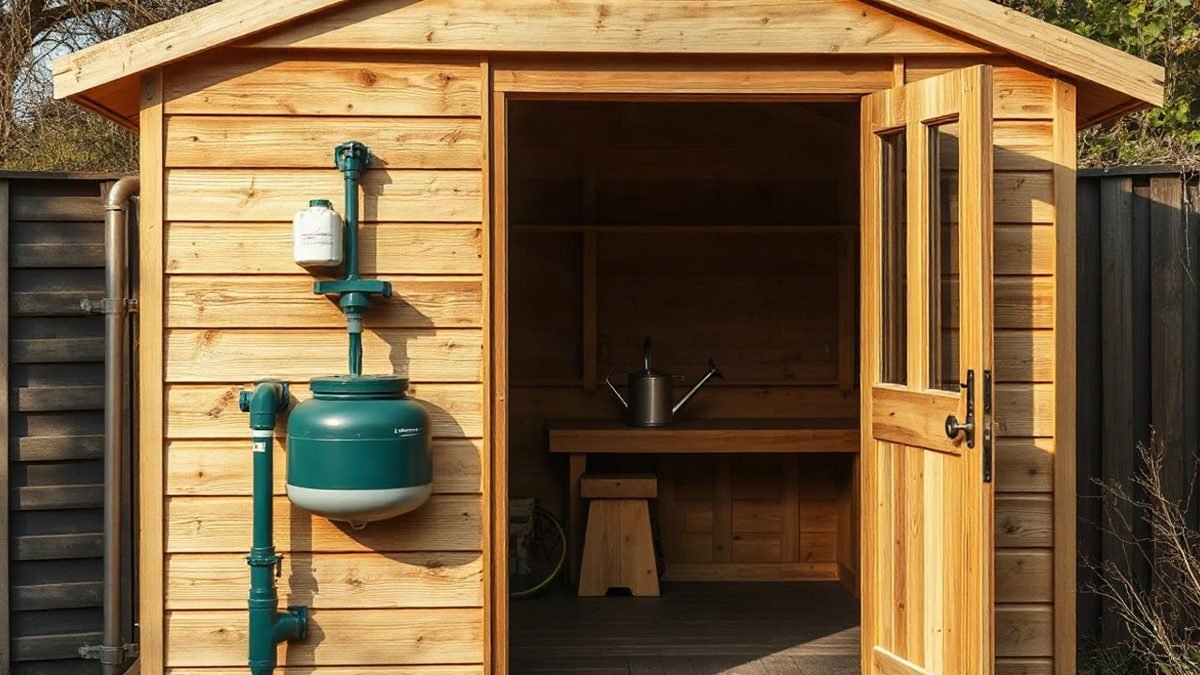
How a basic shed system works
- Collection: rain lands on the shed roof and runs into the gutters and downpipe. The steeper and smoother the roof, the better the collection.
- Diversion and first-flush: a diverter skips the first few litres of each rainfall, which carry the worst of the dust, leaves and bird droppings off the roof.
- Storage: a water butt or tank, ideally opaque to stop algae growth, fitted with an overflow that discharges to a drain or soakaway.
- Distribution: either a gravity-fed tap at the base of the tank, a hand pump, or a small 12V/230V pump feeding a proper tap and sink.
Sizing and standards
If you want to do this properly rather than just sticking a water butt under a downpipe, there is a British Standard covering the design, sizing and maintenance of rainwater harvesting systems in the UK, cited by Stormsaver as BS 16941-1 and by the UKWRA as BS EN 16941-1:2018. It includes a sizing methodology based on storing around 18 days’ worth of rainwater for non-potable use, and Stormsaver notes that a 2024 update incorporated a climate change simulation. The standard also covers the tank-sizing factors of local rainfall, collection area and occupancy (UKWRA).
For a hobby shed, you will rarely need to work to the full standard, but it is useful guidance on tank sizing, and if your system ever grows into something feeding a garden irrigation setup, following it is sensible.
What can you safely use harvested rainwater for?
According to the UK Water Reuse Association, and subject to a system supplier’s risk assessment, untreated harvested rainwater poses no undue risk to health when used for toilet flushing, clothes washing machines and outside taps, plus irrigation and similar activities. What it is not safe for untreated is drinking, cooking or washing yourself.
The UKWRA notes that rainwater can be put through further filtration to make it usable as potable water in off-mains applications, but that water then falls under Private Water Supply Regulations, a meaningful regulatory and maintenance commitment. For a shed workshop, our advice is simple: treat rainwater as non-potable, label the tap clearly, and keep a separate supply of drinking water in the workshop.
Costs and practicalities
A basic setup, water butt, stand, diverter and tap, is one of the cheapest upgrades you can make to a shed. A pumped system with a small sink adds cost and complexity: you will need a frost-proof or drainable arrangement for winter, a stable base for the tank, and leaf guards on the gutters. If your shed is not yet built or you are relocating it, factor tank placement into the site plan: see our guide to building a garden shed foundation for base options that will carry the weight of a full tank safely.
Can I connect my shed to the mains water supply?
If your shed sits within a reasonable distance of the house, a mains connection is often the most sensible “off-grid” answer, even though it is off-grid in name only. You get clean, pressurised, drinkable water year-round with no tanks, pumps or filters to maintain.
The catch is cost and compliance. A buried supply pipe needs to be laid deep enough to protect it from frost damage, insulated where it enters the building, and connected through a properly installed stop valve. Any work on the pipework must comply with the Water Supply (Water Fittings) Regulations 1999, which govern how connections are made to prevent contamination of the mains supply (Stormsaver). In practice, that means using appropriate fittings, and because notification requirements vary, it is worth checking with your water supplier whether they need to be told before you make the connection.
When mains makes sense
- The shed is within roughly 10–15 metres of an existing supply and you are happy to dig a trench.
- You want drinking-quality water and a proper sink in the workshop.
- You plan to heat the space in winter, so freeze protection is manageable.
If the shed is heated and insulated, freezing is less of a concern; if it is unheated, you must lag the pipe and fit drain-down arrangements, or you risk burst pipework every hard frost.
What is a DIY atmospheric water generator, and does it work in a shed?
An atmospheric water generator (AWG) extracts water vapour from the air, usually by chilling a surface below the dew point so condensation forms, much like a dehumidifier. The idea appeals to off-gridders because it needs no roof, no tank farm and no plumbing, just humid air and power.
That last point is the honest caveat. An AWG’s output depends heavily on ambient humidity and temperature: in dry or cold conditions it produces little or nothing, and it consumes electricity throughout. Anyone marketing a DIY AWG build guide should be able to tell you its expected output for your conditions; treat any single headline yield figure with scepticism, because real-world output varies enormously with climate.
One such product is Joseph’s Well, a DIY guide (ebook and videos) that, according to the seller, walks you through building your own atmospheric water generator from parts. It suits tinkerers with spare power capacity who enjoy a build project and want a supplementary water source in a humid environment. It does not suit anyone wanting a guaranteed, predictable water supply; for that, rainwater or mains remain far more reliable, and we would not recommend an AWG as your only source in the UK climate, where cold winters limit output precisely when you might want water most.
Rainwater vs mains vs atmospheric water: which should you choose?
There is no single winner: the best choice depends on your shed, your site and your budget.
- Rainwater harvesting: best all-rounder for UK sheds. Cheap to start, legal without a licence, ideal for non-drinking workshop uses. Needs tank maintenance and winter draining.
- Mains connection: best if the shed is close to the house and you want drinking-quality water and a sink. Highest upfront cost and trenching work, but lowest ongoing effort.
- DIY atmospheric water generator: a supplementary or hobbyist option. Needs power and humid air; output is climate-dependent and should never be relied on as a sole supply.
A sensible approach for many readers: start with rainwater harvesting for workshop tasks, keep bottled water for drinking, and add a mains connection later if your needs grow.
Practical safety notes for shed water systems
- Label the tap. If your supply is untreated rainwater, mark it clearly as not for drinking.
- Prevent backflow. Any mains connection must include appropriate backflow protection to comply with the Water Fittings Regulations; never create a cross-connection between rainwater and mains pipework.
- Drain for winter. Empty tanks, pumps and exposed pipework before hard frosts, or insulate and heat-trace them.
- Keep tanks dark and covered. Opaque, sealed tanks discourage algae and keep debris, insects and vermin out.
- Mind the weight. A full tank is heavy: a 200-litre water butt alone adds 200kg. Ensure the base it sits on can take the load.
- Electrics and water don’t mix. Any pump or AWG in a shed should be on an RCD-protected circuit installed to UK wiring standards.
Affiliate recommendation
Mentioned in this article: Joseph’s Well
Joseph’s Well is a DIY guide that, according to the seller, explains how to build a device that collects water from the air. It is instructions, not a ready-made machine.
Read the seller’s information →
Affiliate link: we may earn a commission if you purchase, at no extra cost to you. We have not tested this product.
FAQ
Do I need planning permission for a rainwater harvesting system on my shed?
No. According to Stormsaver, rainwater harvesting for non-potable reuse does not require planning permission in the UK. If your property is listed or in a conservation area, check with your local planning authority first.
Can I drink harvested rainwater from my shed roof?
Not without treatment. Untreated harvested rainwater is considered suitable for toilet flushing, washing machines and outside taps (UKWRA). Making it potable requires proper filtration and brings the supply under Private Water Supply Regulations. For a workshop, keep drinking water separate.
How big a tank do I need for a shed workshop?
For occasional tool washing and general tidy-up, a 100–200 litre water butt is usually plenty. If you plan to irrigate a garden or run regular washing tasks, size up: BS 16941-1 suggests storing around 18 days’ worth of rainwater for non-potable use as a design benchmark (Stormsaver).
Will a water butt freeze in winter?
Yes, a full one can. Leave some air space at the top (ice expands), or drain the tank and pipework before sustained frosts. Pumps and taps should always be drained or insulated.
Is a DIY atmospheric water generator worth it in the UK?
Only as a supplementary source or a hobby project. It needs electricity and humid air, and output falls sharply in cool, dry conditions, so UK winters are its weak point. Rainwater harvesting is cheaper and far more dependable here.
Wrapping up
Getting water to a shed workshop is one of those upgrades that pays you back every single session. For most readers, the route is clear: a rainwater harvesting setup, even just a diverter and water butt to start, covers nearly every workshop need legally and cheaply, with a mains connection as the upgrade path if your shed is close to the house. If you enjoy a technical build and have power to spare, a DIY atmospheric water generator such as the Joseph’s Well guide could make an interesting supplementary project; just go in with realistic expectations and a rainwater backup. Once the water is sorted, the next job is making the most of the space: our guide to organising a small shed workshop will help you put that new sink and tap exactly where they work hardest.