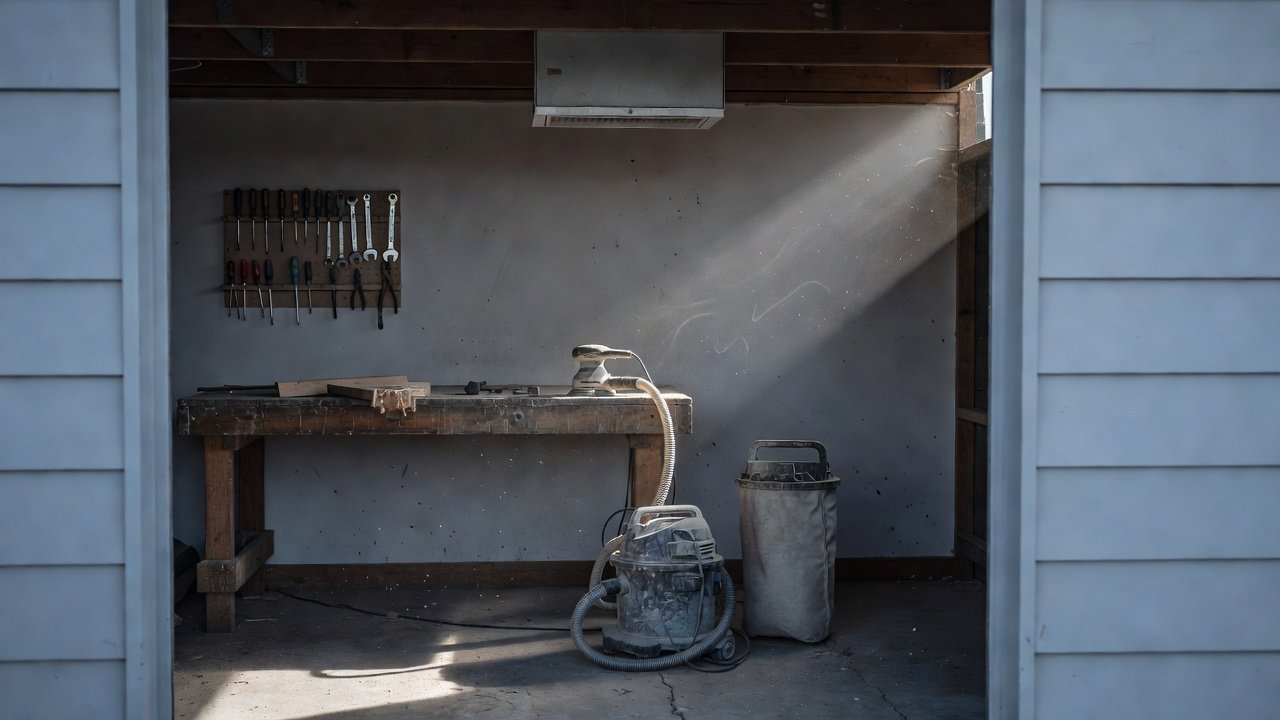
Short answer: For workshop dust extraction, capture dust at the tool first. A shop vac or a dust extractor, both high-suction machines on a small hose, collects chips and fine dust as they are made. An air filter only cleans dust already in the room, so it is a second line, not a substitute. In a small home workshop, pair source capture with a filter that stops fine dust, careful emptying, and a mask for what still escapes. HSE woodworking guidance treats wood dust as a health risk and puts control at source first.
In this guide
- Why wood dust is worth controlling
- What a shop vac, dust extractor and air filter each capture
- Filter classes and the HEPA label
- A sensible setup for a small home workshop
- Habits that matter as much as the machine
- FAQ
- Sources
Why wood dust is worth controlling
Workshop dust extraction is about the dust you breathe, not the pile you can sweep. Chips fall. Fine particles from sanding, routing and sawing stay in the air, settle on ledges, and follow you into the house on your clothes. If you only collect the visible heap, you have missed most of the health problem.
The Health and Safety Executive woodworking guidance treats wood dust as a hazardous substance. It can irritate the eyes, nose and breathing passages. Repeated exposure is linked with asthma and other respiratory disease. Hardwood dust is associated with cancer of the nose and sinuses. Softwood dust is not a safe substitute, and dust from MDF and other boards is very fine and easy to inhale.
The HSE woodworking guidance puts capture at the tool ahead of cleanup. Vacuum the dust. Do not dry-brush it, and do not blow it off the bench with compressed air, because those habits throw it back into the air. A mask has a place when extraction cannot catch everything, including during sanding and when you empty the vac. It is not a replacement for capturing dust.
A hobby shed is not a factory, and employer COSHH duties do not copy across unchanged. The dust is the same. If other people work there, or the garage is a business, read the HSE pages and take advice. This article is general information, not a legal or medical opinion.
What a shop vac, dust extractor and air filter each capture
These three machines are not one product in three sizes. A higher wattage does not mean the dust is dealt with. What matters is whether the airflow reaches the tool, and whether the filter keeps what it caught.
UK catalogue names overlap, so judge the machine by the hose. High suction through a small hose, commonly in the range of about 27 to 50 mm, means a shop vac or a tool dust extractor. High volume through a large hose, commonly about 100 mm, means a chip collector, even if the carton says extractor. A fan and a filter with no hose, fixed to the ceiling or a shelf, means an air filter. The rest of this guide uses those three behaviours.
Match the machine to the job, not to a league table.
| Job | Shop vac | Dust extractor | Air filter |
|---|---|---|---|
| Main job | Cleanup and small tool ports | Small ports, often with a rated filter | Cleans room air after dust escapes |
| Captures well | Grit, small chips, sander dust | Fine dust at a fitted port | Fine dust that stays airborne |
| Struggles with | Heavy shavings and poor filters | The same small-hose limit | Dust still at the tool |
| Filtration | The bag or cartridge you fit | Often an L, M or H class | Pre-filter plus a finer pad |
| Place in a shed | Usual first machine | Useful when you want a stated class | Second line, not the only one |
Shop vacs
A shop vac is a wet and dry vacuum. High suction pulls through a long narrow hose, so it suits a sander, a router fence, a crevice tool and a floor head. Airflow is modest next to a chip collector. On a thicknesser or a wide table-saw hood the hose either plugs with shavings or never gathers the cloud. Use it where the opening is small.
Filtration decides whether you caught the dust or moved it. Coarse foam can stop grit and still blow fine dust out of the exhaust. A fleece bag or a sealed HEPA-style cartridge reduces that, if it actually seals. HEPA on a shop vac names the media, not a test of every joint. A cyclone ahead of the drum keeps chips off the filter. Fine dust still has to be stopped by the filter itself.
Dust extractors
A tool dust extractor uses the same high suction and small hose as a shop vac. On better models you also get a published filter class, fittings that match the tool, hose that resists collapse, and a socket that starts extraction with the tool. Those features are the point of the upgrade. A different shell and a higher price, with the same loose filter, are not. Check the class on the rating plate and whether the motor is meant to run for long sessions.
The airflow limit is unchanged. A hose of around 36 mm is a fair match for a sander, a router or a track saw with a proper port. It is a poor match for a planer. If a small extractor is all you have, put it on the tools that can use it, and do not force it onto a machine that produces a stream of shavings.
Air filters
An air filter, sometimes sold as an ambient air cleaner, pulls room air through a pre-filter and a finer inner filter, then blows it back out. There is no hose and no contact with the cutter. It can only catch dust that is already airborne and that happens to pass through the box. Fine dust hangs in a shed after the saw stops, which is why these units are left running during the job and for a while afterwards.
It does not protect you at the moment of the cut, and it does not empty a saw cabinet. Compare the maker’s airflow or room-size claim with your shed volume in metres: length times width times height. Point the outlet away from your face. Add this unit once the hoses work, not before.
Where chip collectors fit
Chip collectors sit beside this trio and cause most of the naming muddle. They move a lot of air at low suction through hose around 100 mm, which is what carries shavings from a planer or thicknesser. Put the same machine on a small sander port and the fan is starved. Stacking reducers on the hose does not turn it into a vac. The filter is a separate choice: a loose woven bag can dump fine dust back into the room while the sack looks full. Felt bags and cartridge filters are there to improve that.
Floor space and power decide if it belongs in a home shed. A large motor can trip a modest outbuilding circuit on start-up, so read the plate before you plan around it. A collector that blocks the only walkway will sit unused. If you are still fitting bench, saw and storage into one bay, see how to fit a fully functional woodworking shop into a small space before the collector takes the aisle.
Filter classes and the HEPA label
None of these machines help if the filter leaks. Dust leaving the exhaust is dust you breathe.
Trade vacuums are often graded L, M or H under EN 60335-2-69. L lets through the most, then M, then H. The usual efficiency floors are 99 percent, 99.9 percent and 99.995 percent. Wood dust is awkward to rank from a single number: it can cause asthma, and hardwood dust is carcinogenic, but the exposure-limit band alone will not choose the machine for you. M-class is the grade most often sold for woodworking extractors, and a sensible baseline to look for. H-class is tighter. A domestic shop vac is not in that system unless it has been certified. Read the plate, and take the health context from HSE woodworking guidance rather than the carton.
HEPA is not a machine class
HEPA is a different label. It means the filter media can catch a very high share of fine particles. Printed on a shop vac cartridge or an air-filter pad, it is not the same thing as an M-class or H-class test of the whole machine, seals included. A HEPA cartridge that sits flat is still a clear step up from open foam. A warped lid that bypasses it is not. When the filter blinds, take it outside and tap it out, or replace it, with a mask on. Blasting it with compressed air indoors puts the trapped dust straight back into the workshop.
A sensible setup for a small home workshop
A sensible small-workshop setup follows the dust that gets into your lungs, in this order.
- Start with the sander. Fit a shop vac or dust extractor to the port, use a fleece bag or a fine cartridge, and add a pre-separator if you sand for long. You lean over this tool, and the dust is as fine as anything in the shed.
- Connect tools with a proper shroud, such as a track saw or a router. Expect less dust, not none. A mitre saw throws much of its dust past the port: keep the hose on, then vacuum what lands on the floor.
- Add a chip collector only for machines that make a flow of shavings, and only if the circuit and the floor can take it. If they cannot, make those cuts and clean up with the vac. A blocked 36 mm hose is a mismatch, not proof that extraction fails.
- Then add the air filter. Run it while you work and after you stop, sized from the maker’s figures and the room volume. It picks up what the hoses miss. It does not replace them.
- Keep a mask for the gaps: sanding, the mitre saw, and emptying. Woodworkers commonly use a well-fitted FFP3 disposable mask, or a half mask with P3 filters, for this fine dust. A poor seal makes the rating irrelevant. Where workplace rules apply, follow the HSE guidance on respiratory protection rather than guessing.
Habits that matter as much as the machine
Get the everyday habits right or the kit will not matter. Empty the container before it is packed, outdoors or into a bag you close at once, and wear a mask while you do it. Hang the hose so it is not crushed underfoot. Keep a spare filter you can actually reach, which means giving extraction kit a home: storage ideas for a small shed workshop apply to hoses and filters as much as to clamps. Check that lids still latch and that joints have not split. A leak after the filter blows dust back into the room.
FAQ
Is a shop vac enough for a home workshop?
For sanders, routers, track saws and floor cleanup, it often is, provided the filter holds fine dust and you keep it clear. It is not enough for a planer or thicknesser. The hose cannot move that volume of shavings.
Can an air filter replace workshop dust extraction?
No. By the time room air reaches a ceiling unit, you have already breathed the cloud at the tool. Use the filter to catch what the hose misses, and leave it running after you stop. Do not use it as the only control.
Is a HEPA filter the same as M-class?
No. HEPA describes the filter material. M-class and H-class are machine grades under EN 60335-2-69, covering leakage as well as the media. A sealed M-class extractor can beat a leaky vac with a HEPA sticker. Check the plate, then check the seals.
Do I still need a mask if I have extraction?
Yes, for the gaps. Sanders and mitre saws still throw some dust, and emptying a drum is a short, heavy exposure. A well-fitted FFP3 mask, or P3 filters on a half mask, is a common choice. HSE guidance treats masks as support for extraction, not a replacement.
Should I dry-sweep, or blow the dust outside?
Do not dry-sweep or blow the bench down with compressed air. Both put dust back into the air, which cuts against HSE advice. Blowing extraction outdoors skips the filter and the heat, and it can annoy neighbours. If you recirculate, the filter is the control, so it has to seal.
Sources
- HSE: Woodworking. Overview of health risks from wood dust and the case for controlling it at source.